Species
Native and endemic to Chile

In Purranque, we grow Chile’s native and endemic species to help conserve and restore the forests of southern Chile and Patagonia.
Native and endemic to Chile
Sustainable growing
Committed to our forests
Delivery to locations across Chile
31 species to discover
Roots that matter
Understanding what a forest supports helps us choose what to plant and how to support its recovery.
1 of 5A home for life
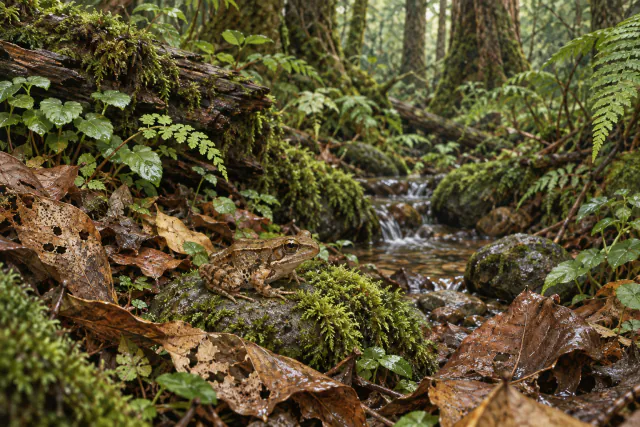
Shelter, moisture and leaf litter: a closer look at habitat.
A figure in context
80 %
of the world’s amphibian species find habitat in forests.
The 2020 FAO and UNEP report shows how much biodiversity depends on that home. Conserving a forest also protects the environments that other forms of life need.
Global · 2020 report
FAO / UNEP (opens in a new tab)Visual exploration
The canopy is only one part of a forest.
Trees, shrubs and low-growing plants create different environments. This vertical structure influences where wildlife finds resources. Explore the whole forest, then take a closer look at its lower layers.
General ecological principle
FAO (opens in a new tab)Ecological relationship
Notro and the green-backed firecrown meet around nectar.
The green-backed firecrown (Sephanoides sephaniodes) is among its pollinators in studied southern populations. While visiting flowers, it can transfer pollen. The visitors and their frequency vary between locations.
Chiloé and Puerto Blest · 2006 study
Rovere et al. · RCHN (opens in a new tab)Natural process
Wildlife also helps shape the forest’s future.
Some animals carry seeds and contribute to their dispersal. Caring for these visitors’ habitat helps sustain a process on which many plants depend for regeneration.
General ecological principle
FAO (opens in a new tab)A landscape perspective
Conservation extends beyond a property boundary.
FAO recommends reducing fragmentation and maintaining ecological connections between habitats. Considering a site alongside the surrounding forests helps guide action at a landscape scale.
International guidance · updated 2021
FAO (opens in a new tab)Visual comparison
A raindrop lands differently on bare soil and on leaves.
Low-growing vegetation and leaf litter soften the impact of rain. Compare surface protection under two conditions in the same scene.
General process · no site measurements
FAO (opens in a new tab)Below the surface
Soil structure matters as much as what we see above ground.
Water can infiltrate porous forest soils. Avoiding compaction and retaining organic matter help protect that structure.
General soil and water principle
FAO (opens in a new tab)An open question
Planting does not guarantee more available water.
Trees also use water and return some to the atmosphere. The balance depends on climate, soil and vegetation. Protecting water quality and increasing water quantity are different goals.
International synthesis · 2007
FAO · Calder et al. (opens in a new tab)Where systems meet
Riverbank vegetation connects forests and water.
It can trap sediment and help protect banks. CONAF identifies soil, wetland and headwater conservation among the aims of native forest restoration.
General process; Chilean context · CONAF 2023
FAO (opens in a new tab)Life in the soil
A fallen leaf changes form and rejoins the cycle.
Small invertebrates break plant remains into fragments; microorganisms continue their decomposition. Moisture, temperature and the material available influence this process.
General biological process
FAO (opens in a new tab)Forest recovery
A tree that grows on its own deserves care too.
Assisted natural regeneration reduces barriers such as grazing or fire. It can be combined with planting when the site and project aims call for it.
International guidance
FAO (opens in a new tab)Before planting
Being native does not make a species suitable for every piece of land.
Define what you want to restore and observe light, moisture, soil and existing vegetation. Species and methods should respond to those conditions, with follow-up care planned from the start.
General restoration criteria
FAO (opens in a new tab)Practical care
The first roots should be at ground level.
Find where the trunk widens and the first roots emerge. Burying that area too deeply can hinder establishment. Check the depth before filling the planting hole.
Horticultural guidance · United Kingdom
Royal Horticultural Society (opens in a new tab)Practical care
A damp surface can hide dry roots.
Carefully check moisture beside the root ball before watering. Too much water can also cause harm, especially where drainage is poor. Adapt watering to the soil, climate and the plant’s establishment.
Horticultural guidance · United Kingdom
Royal Horticultural Society (opens in a new tab)After planting
Planting is an intervention; recovery is a process.
Recording survival, growth and threats helps you assess what works and adjust care. Monitoring also includes vegetation that regenerates naturally.
International guidance
FAO (opens in a new tab)Species story
A rainforest tree that stands out when it blooms.
Its fragrant white flowers contrast with the foliage. Ulmo is part of the Valdivian forest of Chile and Argentina. Understanding that habitat is a useful starting point when considering where to plant it.
Before choosing. Check moisture, space for growth and protection during establishment.
Valdivian forest of Chile and Argentina · 2021 account
Int. Dendrology Society (opens in a new tab)Species story
Notro’s flowers also tell a story about where it grows.
In the populations described in Chiloé and Puerto Blest, it occurs at forest edges and in open areas. That observation invites us to consider light and surroundings before choosing its place.
Before choosing. Assess light, moisture and drainage for your location.
Chiloé and Puerto Blest · 2006
Rovere et al. · RCHN (opens in a new tab)Botanical feature
Cinnamon colour is part of its appeal.
As it matures, the smooth bark peels in sheets to reveal paler patches. This texture makes arrayán rewarding to observe even when it is not flowering.
Before choosing. Sun or partial shade; soil with organic matter and good drainage.
Species from Chile and Argentina · Oregon horticultural guide
Oregon State University (opens in a new tab)Botanical discovery
Its dry fruit opens into a distinctive shape.
Quillay has persistent leathery leaves and fruit that opens into a star. Native to central Chile, it tolerates drought, but still needs care when first planted.
Before choosing. Sun to partial shade and well-drained soil; plan for watering during establishment.
Central Chile · description and horticultural guidance
Oregon State University (opens in a new tab)Diversity within a species
Diversity within a species deserves protection too.
INIA Kampenaike maintains calafates from different environments in Magallanes in a living collection. Their genetic diversity is a reason to ask where plants come from.
Before choosing. Ask about plant origin and compatibility with your soil and light conditions.
Magallanes, Chile · INIA initiative, 2025
INIA Kampenaike (opens in a new tab)Forests of southern South America
Explore the natural range of the species we grow. Some are found only in Chile; others also grow in Argentina’s temperate and Patagonian forests.
Choose a species to reveal its natural range.
On a computer, you can also explore with the pointer or keyboard.