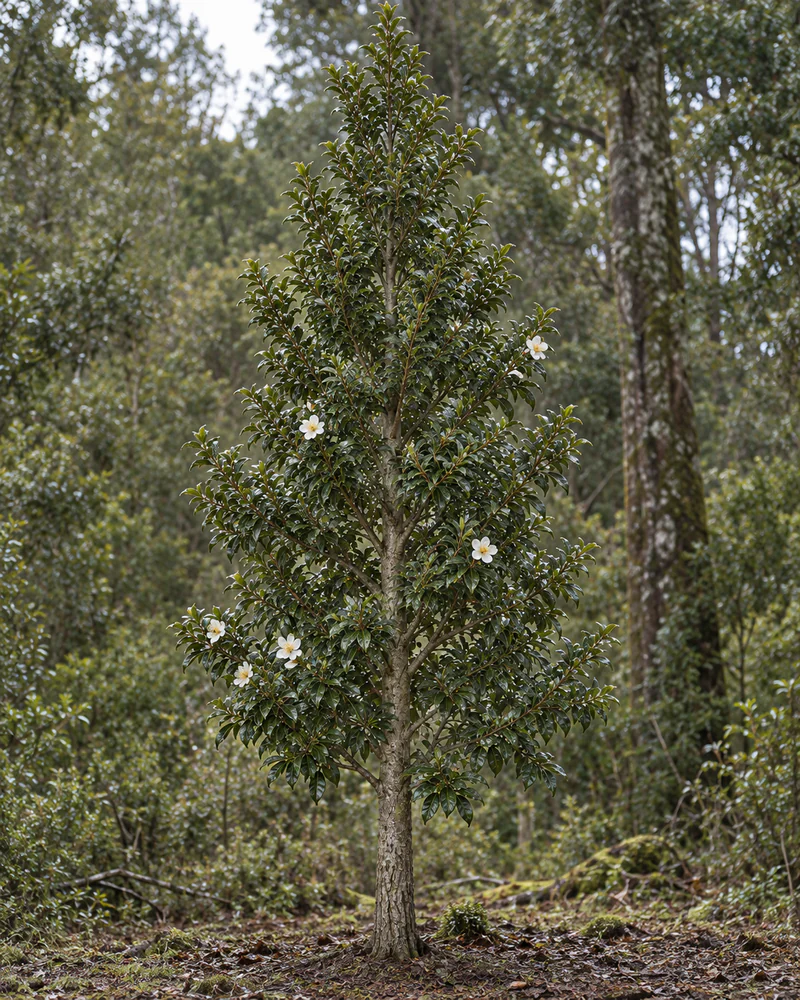
Whole plant
A view of the whole plant. Use the style selector to explore this species as an illustration or a photorealistic image.
The illustrated and photorealistic images were created with AI as visual references. Individual plants may differ in appearance, shape, size, colour and stage of growth.
Tree
Ulmo
Eucryphia cordifolia
A large evergreen tree with heart-based leaves and abundant white flowers.
Botanical description
About this species
Ulmo is an evergreen tree of temperate rainforests in south-central Chile and neighbouring parts of Argentina. It is distinguished by leaves with heart-shaped bases and serrated margins, along with conspicuous, nectar-rich white flowers.
Species geography
Natural distribution
Native to ChileGrows naturally from Biobío to Aysén and in the Andean forest belt of Neuquén, Río Negro and Chubut.
Habitat. Temperate rainforests at low and middle elevations, on cool, deep soils.
Chile
- Biobío
- La Araucanía
- Los Ríos
- Los Lagos
- Aysén
Argentina
- Neuquén
- Río Negro
- Chubut
Latitude range: Approximately 36°–45° S
Species profile
Characteristics
- Local name
- Ulmo
- Scientific name
- Eucryphia cordifolia
- Plant type
- Tree
- Origin
- Native to Chile, also occurring naturally in Argentina.
- Foliage
- Evergreen leaves with heart-shaped bases and serrated margins.
- Distinctive feature
- Abundant white flowers visible across the crown.
- Ecological role
- Its flowers are an important nectar source for pollinators.
Getting started
Planting and care
Light
Partial shade or filtered light while establishing; introduce sun gradually.
Watering
Water regularly, maintaining steady moisture without standing water.
Soil and planting
Cool, deep soil with organic matter and good drainage. Provide wind protection at first.
Suitable conditions depend on the plant’s provenance, soil and microclimate. Check recommendations for your project with the nursery before planting.