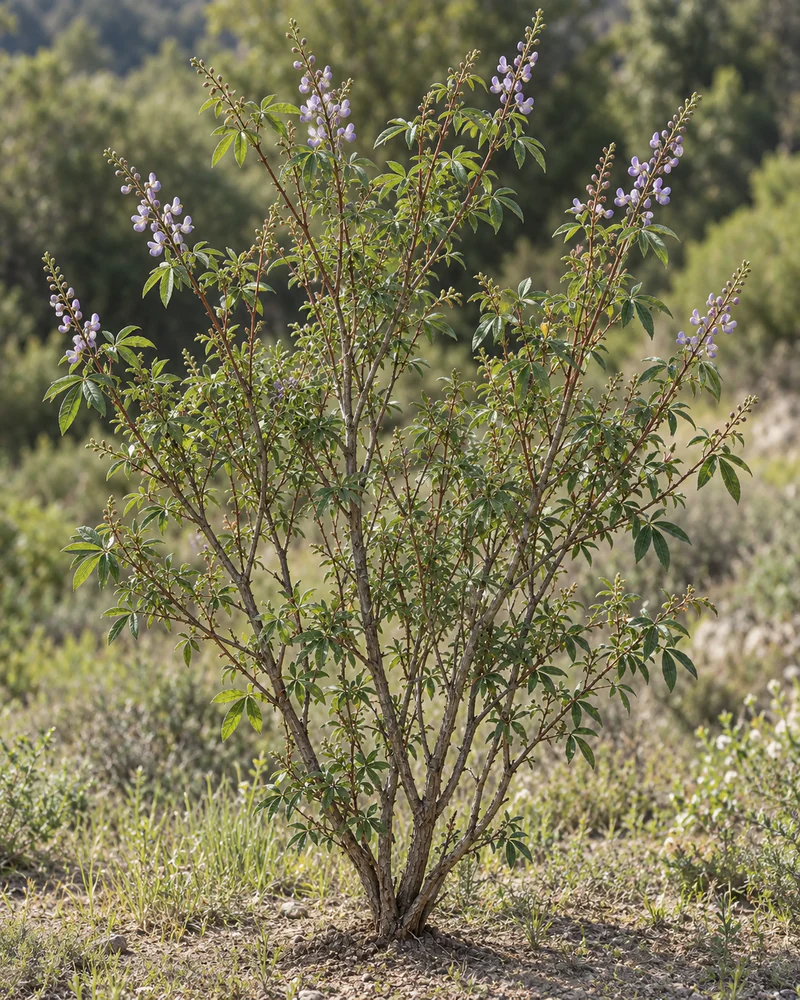
Whole plant
A view of the whole plant. Use the style selector to explore this species as an illustration or a photorealistic image.
The illustrated and photorealistic images were created with AI as visual references. Individual plants may differ in appearance, shape, size, colour and stage of growth.
Shrub or small tree
Culén
Otholobium glandulosum
An aromatic legume with three-part leaves and bluish to violet flowers.
The catalogue keeps the scientific name under which this species was recorded. Its currently accepted name is Grimolobium glandulosum.
Botanical description
About this species
Culén is an aromatic legume that usually grows as a shrub or small tree. It can be recognised by its compound leaves with three leaflets and clusters of bluish or violet flowers. Its native range extends through the Andean region into Chile.
Species geography
Natural distribution
Native to ChileIn Chile it occurs from the far north to Los Ríos. Its native range continues into Bolivia and Perú, beyond this map.
Habitat. Ravines, slopes, watercourse edges and disturbed sites in the Andean and Mediterranean belt.
Chile
- Arica y Parinacota
- Tarapacá
- Coquimbo
- Valparaíso
- Metropolitana
- O’Higgins
- Maule
- Ñuble
- Biobío
- La Araucanía
- Los Ríos
The natural range extends into Bolivia and Perú, beyond the area shown on this map.
Latitude range: Approximately 18°–40° S in Chile
Species profile
Characteristics
- Local name
- Culén
- Scientific name
- Otholobium glandulosum
- Plant type
- Shrub or small tree
- Origin
- Native to Chile, also occurring naturally in Bolivia and Perú.
- Foliage
- Aromatic, gland-dotted leaves with three leaflets.
- Distinctive feature
- Clusters of bluish or violet flowers.
- Taxonomic note
- The currently accepted name is Grimolobium glandulosum.
Getting started
Planting and care
Light
Sun or light partial shade, with gradual acclimatisation after transplanting.
Watering
Moderate watering while establishing; space it out once rooted, according to the site.
Soil and planting
Good drainage is preferred. Avoid compacted soil and adapt care to the local climate.
Suitable conditions depend on the plant’s provenance, soil and microclimate. Check recommendations for your project with the nursery before planting.