
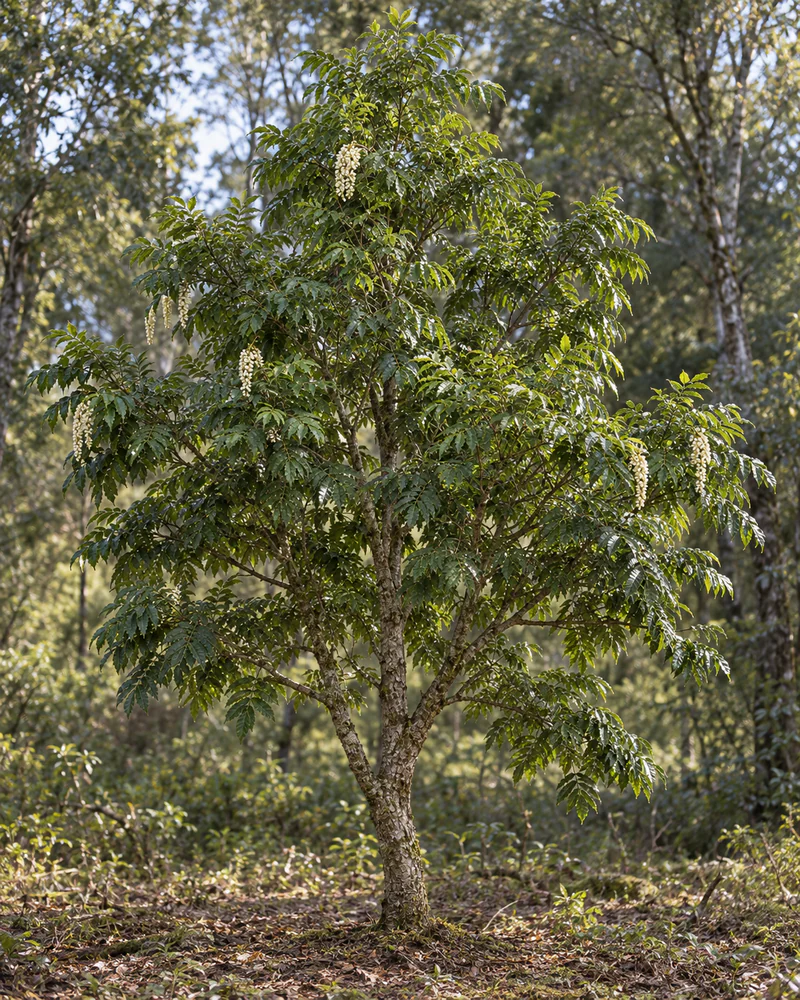
Whole plant
A view of the whole plant. Use the style selector to explore this species as an illustration or a photorealistic image.
The illustrated and photorealistic images were created with AI as visual references. Individual plants may differ in appearance, shape, size, colour and stage of growth.
Tree
Avellano
Gevuina avellana
An evergreen tree with compound leaves, pale flowers and fruit that changes colour as it ripens.
Botanical description
About this species
Chilean avellano belongs to the Proteaceae family and grows in the temperate forests of southern South America. It has glossy compound leaves, whitish flower clusters and rounded fruit that turns from green to red, then dark as it ripens.
Species geography
Natural distribution
Native to ChileIts main range extends from south-central Chile to Aysén, with neighbouring populations in Andean Patagonia in Argentina.
Habitat. Temperate forests and their edges, on deep, relatively moist soils.
Chile
- O’Higgins
- Maule
- Ñuble
- Biobío
- La Araucanía
- Los Ríos
- Los Lagos
- Aysén
Argentina
- Neuquén
- Río Negro
- Chubut
Latitude range: Approximately 34°–45° S
Species profile
Characteristics
- Local name
- Avellano
- Scientific name
- Gevuina avellana
- Plant type
- Tree
- Origin
- Native to Chile, also occurring naturally in Argentina.
- Foliage
- Glossy, compound evergreen foliage.
- Distinctive feature
- Round fruit that changes colour during ripening.
- Ecological role
- Its flowers and fruit provide resources for local wildlife.
Getting started
Planting and care
Light
Gentle sun to partial shade, depending on the climate and growth stage.
Watering
Water regularly while roots establish; avoid prolonged dryness and waterlogging.
Soil and planting
Deep, cool, well-drained soil. Organic mulch helps retain moisture.
Suitable conditions depend on the plant’s provenance, soil and microclimate. Check recommendations for your project with the nursery before planting.