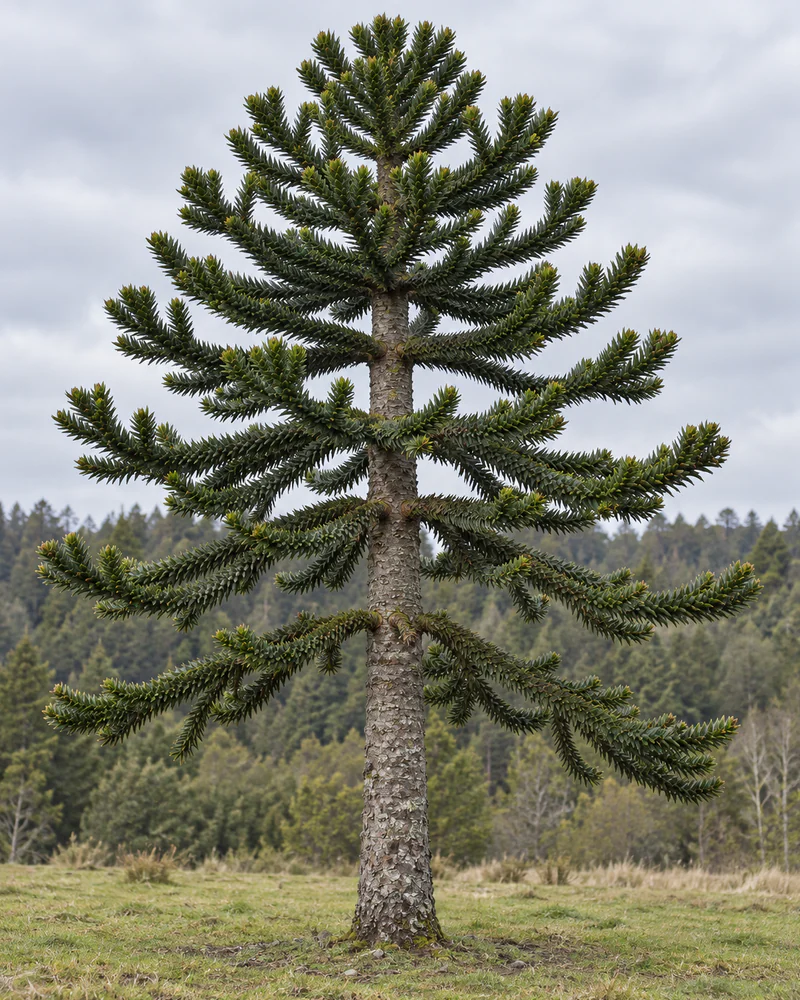
Whole plant
A view of the whole plant. Use the style selector to explore this species as an illustration or a photorealistic image.
The illustrated and photorealistic images were created with AI as visual references. Individual plants may differ in appearance, shape, size, colour and stage of growth.
Conifer
Araucaria
Araucaria araucana
A majestic evergreen conifer, recognised by its whorled branches and rigid leaves.
Botanical description
About this species
Araucaria is a long-lived conifer of the temperate Andean and coastal forests of south-central Chile and neighbouring Argentina. It develops a straight trunk, a distinctive crown and persistent, leathery triangular leaves. Its large cones produce seeds known locally as piñones.
Species geography
Natural distribution
Native to ChileA discontinuous native range in the Cordillera de Nahuelbuta and the Andes of south-central Chile, as well as Neuquén, Argentina.
Habitat. Mountain forests on volcanic soils and high areas of the Cordillera de Nahuelbuta.
Chile
- Biobío
- La Araucanía
- Los Ríos
Argentina
- Neuquén
Latitude range: Approximately 37°30′–40° S
Species profile
Characteristics
- Local name
- Araucaria
- Scientific name
- Araucaria araucana
- Plant type
- Conifer
- Origin
- Native to Chile, also occurring naturally in Argentina.
- Foliage
- Evergreen, rigid leaves densely arranged along the branches.
- Distinctive feature
- Whorled branches and large woody cones.
- Ecological role
- A structural species in temperate forests and a food source for native wildlife.
Getting started
Planting and care
Light
Plenty of light in a cool environment; protect young trees from extreme heat and wind.
Watering
Water regularly while roots establish, without saturating the growing medium.
Soil and planting
Cool, well-drained soil. Ask the nursery about suitability for warm or coastal sites.
Suitable conditions depend on the plant’s provenance, soil and microclimate. Check recommendations for your project with the nursery before planting.